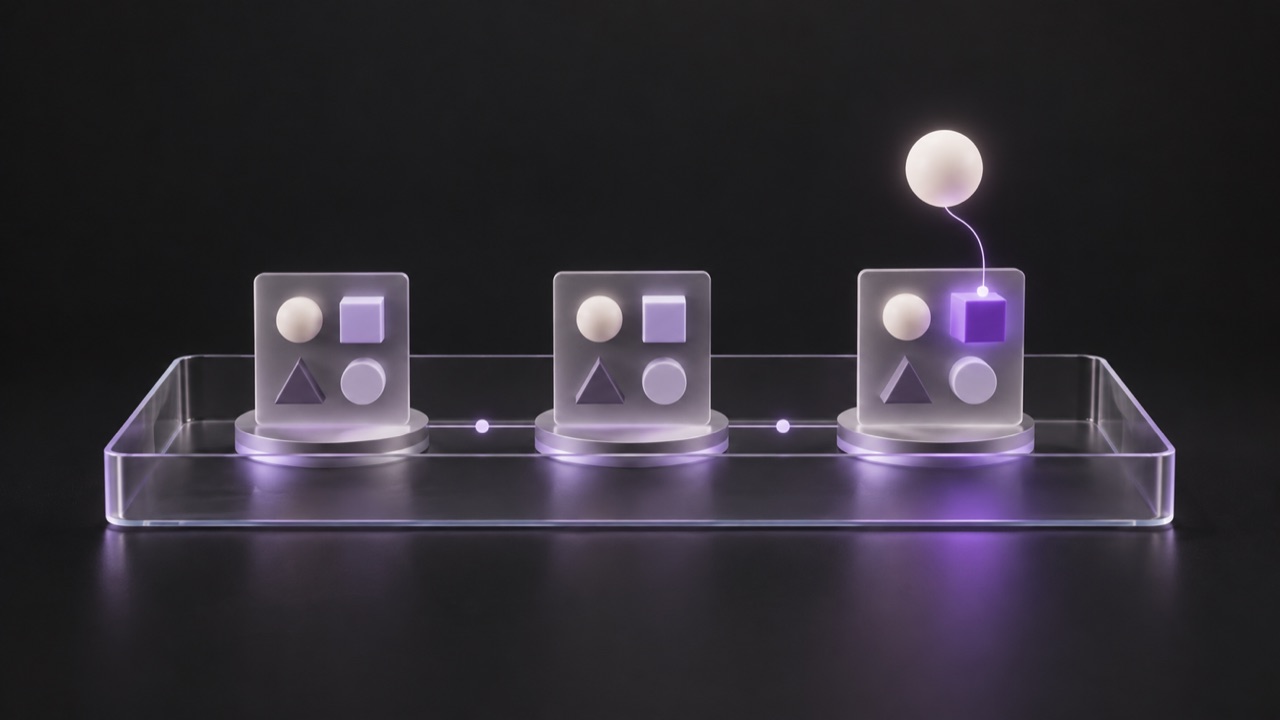
This article discusses external research and product documentation. Its illustration is conceptual and it is not an announcement of PersonaSI product functionality.
An agent that prepares a presentation or reorganizes a workbook creates a practical design problem: where can someone notice a misunderstanding and change course? By October 2026, product releases and research are offering concrete answers. Interactive controls, artifact-level feedback, scheduled checkpoints, and demonstrations create different ways to express intent. The opportunity is to connect them into a coherent working relationship.
Generate controls around the task
On October 7, OpenAI introduced Intelligent UI in ChatGPT: responses can contain buttons, forms, charts, and interactive experiences. A library of native, streamable components lets the interface appear progressively. The announcement describes tools such as a bill splitter and interactive explanations whose inputs people can change. OpenAI’s announcement ↗
For designers, the useful principle is specificity. A visible field for the number of guests can make a revision easier to express than another paragraph. But generated controls need clear semantics. Changing a preview, saving a preference, and authorizing an external action must remain distinguishable. The release concerns ChatGPT’s Chat experience; it does not establish that every agent workflow now has these controls.
Put feedback beside the thing being changed
OpenAI’s February 2 Codex app announcement describes reviewing changes inside a task thread, commenting directly on a code diff, and opening the work in an editor for manual changes. Separate worktrees support parallel experiments on isolated copies. Codex app announcement ↗
This suggests a pattern beyond software development: keep the agent’s proposal beside the object under review. A spreadsheet correction should point to the affected cells. A slide revision should identify the selected element. Preserve the connection between feedback and its target when the agent resumes. A fluent summary is insufficient evidence that the underlying artifact is correct.
Ask at moments when correction is still affordable
A CHI 2026 paper, published on April 13, examines when users should check a multi-step agent task. In a controlled study with 48 participants, 81% preferred intermediate confirmations over checking only at the end. Average completion time fell by 13.54%. The researchers model the time spent checking, diagnosing errors, correcting them, and redoing subsequent work. When Should Users Check? ↗
These results come from a simulated evaluation environment, so they are not a universal performance promise. They do support treating interruption timing as a design variable. A useful checkpoint should show the state being checked, the consequential difference, and the available correction. Permission to act and verification of correctness also deserve separate treatment: approving access does not validate the agent’s interpretation.
Make demonstrations inspectable
Tencent’s UI-Mate technical report, submitted August 16, describes demonstration-guided computer use. Recorded actions and screenshots become subtask-level workflows that guide execution while the agent replans against the live interface. Its documented desktop client supports demonstration capture and editing, step-by-step inspection, and pause and resume controls. UI-Mate report ↗, official repository ↗
This is a concrete route for teaching procedures that are awkward to describe: which fields matter, how files are named, or what completion looks like. The interaction should expose the extracted procedure so people can correct what the agent inferred. A supplied demonstration guides inference; it should not be described as permanently retraining the model. Recordings can also contain confidential information, making preview, redaction, and retention controls important design requirements.
Evaluate the whole correction loop
Together, these examples suggest a practical prototype: an editable task outline, a live artifact, contextual checkpoints, and a recoverable history. Keep actions with external consequences behind explicit, stable controls, even when the surrounding interface is generated.
Test whether people can detect a wrong assumption, locate its source, repair it, and verify the result. Measure correction time and unnoticed errors alongside completion rate. The strongest agent interface gives people a clear place to exercise judgment while work is still taking shape.
Sources
- GPT-6 and Intelligent UI for everyone ↗OpenAI · 2026-10-07 · Reviewed 2026-10-10
- Introducing the Codex app ↗OpenAI · 2026-02-02 · Reviewed 2026-10-10
- When Should Users Check? Modeling Confirmation Frequency in Multi-Step Agentic AI Tasks ↗ACM CHI 2026 · 2026-04-13 · Reviewed 2026-10-10
- UI-Mate: Advancing Open-Weight Foundation GUI Agents with In-Context Demonstrations ↗Tencent HY Frontier / arXiv · 2026-08-16 · Reviewed 2026-10-10
- UI-Mate official repository ↗Tencent HY Frontier · Publication date not displayed · Reviewed 2026-10-10