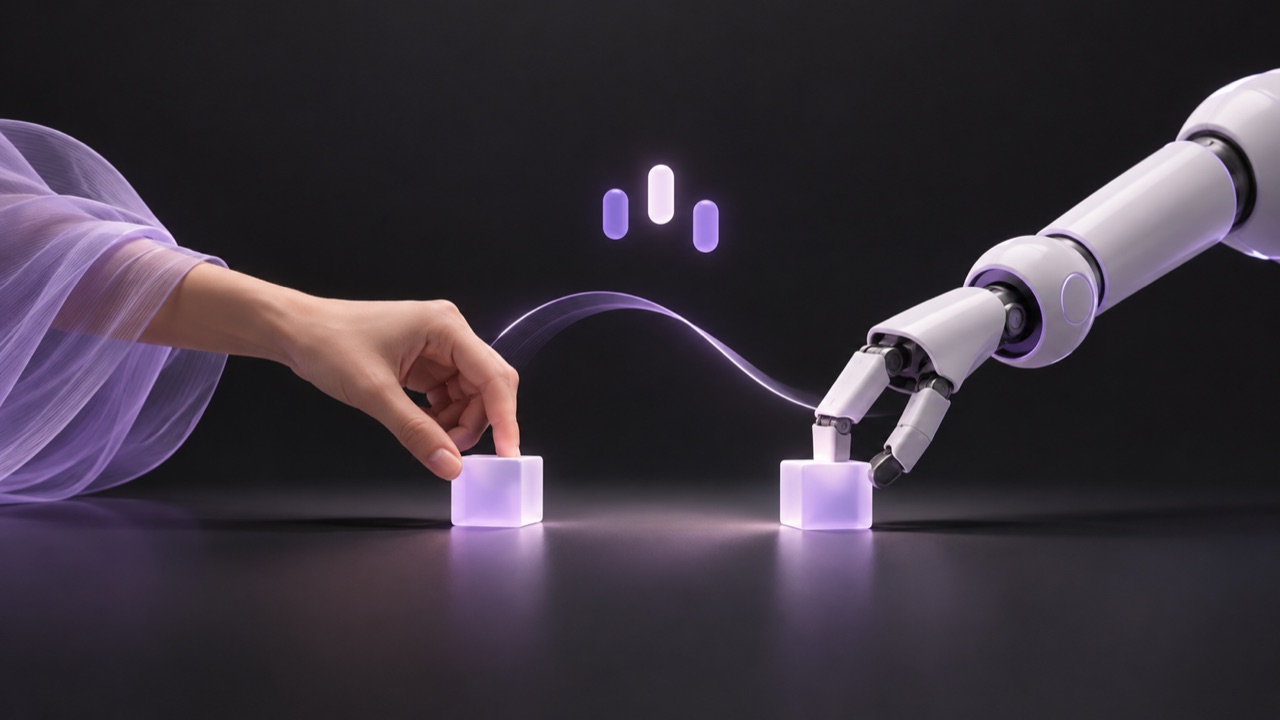
This article discusses external research and product documentation. Its illustration is conceptual and it is not an announcement of PersonaSI product functionality.
Teaching a robot asks a person to do several different jobs. They might demonstrate a movement, explain an error, or decide whether another attempt is good enough. Each job needs a different kind of feedback. A recording button captures an example, but it gives the teacher little help understanding what the machine learned from it.
Three robotics projects published in 2026 make this interaction more visible. Together, they suggest useful questions for PersonaSI’s work on personally trained specialist software agents: how can an interface help someone teach well, preserve a correction and identify the next useful lesson?
Help the person demonstrate
GLIDE begins with a familiar difficulty: knowing how to complete a task does not guarantee that someone can reproduce it through robot controls. Its September 21 preprint describes software that generates task-specific filters for teleoperation commands, then improves them using recorded attempts. A person still directs the robot. Assistance can coordinate the grippers carrying a plate or help maintain alignment while pouring. GLIDE paper, version 1 ↗, demonstrations ↗
This changes the teaching experience. The interface helps the demonstrator produce a useful example while they work. For a software-agent analogy, imagine teaching a research specialist with an example brief while the workspace highlights missing evidence. The proposed assistance would help the person complete the example before saving it for training.
There is an important evaluation boundary. GLIDE’s deployment experiments use ten robot trials per condition. Removing the filters reduced success in the authors’ comparison, so its strongest results describe a combined learning-and-assistance system. A polished demonstration should be assessed with that dependency visible. Evaluation and limitations ↗
Let a correction become a lesson
ARCHITECT, a July 26 preprint, explores a different interaction. A person observes a failed attempt and supplies a natural-language correction. The system uses execution traces to revise robot programs, retaining reusable rules or code patterns in a skill library. Its implementation includes a command-line interface for corrections, inspecting the program, viewing the library, undoing changes and removing skills. ARCHITECT paper, version 1 ↗, published interface ↗
The design opportunity is a visible saved lesson. For a research specialist, a correction might become a rule to include the denominator whenever reporting a percentage. A proposed lesson card could show the original mistake, the new rule, its intended scope and examples used to test it.
ARCHITECT’s six-person study provides early evidence that stored skills can reduce repeated corrections on related tasks. Its small scale and dependence on perception and control tools keep the conclusion bounded. Importantly, this form of adaptation accumulates contextual skills; users should be able to distinguish it from updating model weights. Study and limitations ↗
Ask for help at the right moment
LOPAL, first posted June 15 and accepted in IEEE Robotics and Automation Letters, makes the request for teaching physical. It combines good sections from imperfect demonstrations. Where good examples are missing, the robot slows down and gives a visual cue; the person can guide it through the difficult section. The physical study involved eight participants teaching a pipe-tracing task. LOPAL paper, version 1 ↗, project ↗
For a software training interface, a comparable proposal is a specific request: show one example of how to handle conflicting sources. That gives the teacher a concrete next step. A progress display could show which situations have been tested and which still need examples.
What PersonaSI could explore
These are research-inspired proposals for specialist-agent training. A useful teaching workspace could distinguish an assisted example, a saved correction and a validated behavior. It could make scope and undo controls easy to find, explain when external checks are doing the work, and ask targeted questions when evidence is missing.
The next test would measure both agent quality and the teacher’s experience: time spent correcting, repeated mistakes, unwanted generalization and performance on unfamiliar cases. Better teaching interfaces should make progress understandable as well as measurable.
Sources
- Learning Beyond What Humans Can Demonstrate ↗arXiv; author comment lists acceptance at CoRL 2026 · 2026-09-21 · Reviewed 2026-10-10
- A Few Words Go a Long Way: Language Guided Robot Policy Synthesis ↗arXiv · 2026-07-26 · Reviewed 2026-10-10
- ARCHITECT Franka interface documentation ↗ARCHITECT authors · Publication date not displayed · Reviewed 2026-10-10
- LOPAL: Local Performance-Aware Active Learning from Imperfect Demonstrations ↗IEEE Robotics and Automation Letters / arXiv · 2026-06-15 · Reviewed 2026-10-10
- LOPAL project demonstrations ↗LOPAL authors · Publication date not displayed · Reviewed 2026-10-10